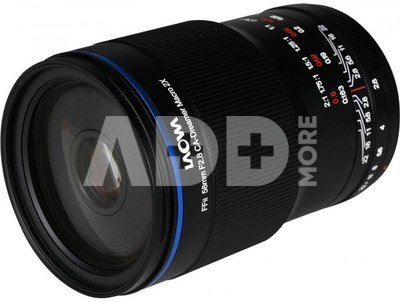
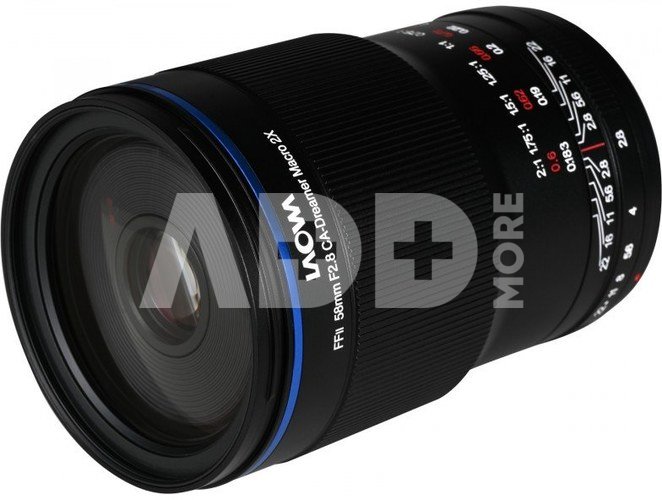
Laowa 58mm f/2.8 2X Ultra-Macro APO L mount
Laowa 58mm f/2.8 2X Ultra Macro APOProviding an impressive 2X magnification, the Laowa 58mm f/2.8 lens allows photographers to capture intricate details at twice life-size, uncovering textures and subtleties typically invisible to the naked eye. Its advanced Apochromatic (APO) optical construction eliminates chromatic aberrations and color fringing, ensuring exceptional sharpness, accurate color rendering, and superb contrast throughout the entire frame. Featuring an internal focusing mechanism, the lens maintains a consistent physical length during focusing, which enhances stability, handling, and compatibility with macro accessories. Additionally, its lightweight and compact build makes handheld shooting comfortable, enabling photographers to maneuver effortlessly and capture stunning macro shots in various environments.The lens employs a sophisticated optical design comprising 14 elements arranged in 11 groups, including three extra-low dispersion (ED) elements and three ultra-high refractive index elements. This advanced configuration ensures optimal resolution, minimizes distortion, and consistently maintains high image quality from the center to the edges of the frame.Key Features:Focal length: 58mm, ideal for macro photography, portraits, and general useMaximum magnification: 2X (twice life-size)Aperture range: f/2.8 – f/22Advanced Apochromatic (APO) design reduces chromatic aberrationsInternal focusing mechanism for improved handling and stabilityLightweight and compact construction, ideal for handheld shootingOptical design: 14 elements in 11 groups (3 ED elements, 3 ultra-high refractive index elements)Exceptional sharpness and color accuracyMinimum focusing distance: 18.5cmAvailable mounts: Sony E, Canon RF, Nikon Z, Leica LThe Laowa 58mm f/2.8 2X Ultra Macro APO lens combines impressive magnification, versatile focal length, and premium optical quality. With its lightweight design, advanced internal focusing mechanism, and superior optical construction, this lens is perfectly suited for photographers looking to capture extraordinary detail with precision and ease.What's in the boxLaowa 58mm f/2.8 2X Ultra Macro APO LensFront and Rear Lens CapsLens HoodProtective Lens Pouch
Max Aperture
2.8 F
Focal length Movie
58 mm
Warranty
24 months
Discuss with a consultant in Kaunas
We don't have
Klaipėda Address: Birželio 23-iosios g. 23g Working hours: I-V 09:00 - 18:00 VI-VII not working Phone: +370 674 59488
Discuss with a consultant in Klaipėda
We don't have
Klaipėda Address: Taikos pr. 17 Working hours: I-V 10:00 - 19:00 VI 10:00 - 14:00 VII not working Phone: +370 604 43972
1. How to choose the right lens for a mirrorless camera?
When choosing the right lens for a mirrorless camera, it is important to consider your photography needs and style. First, decide on the resolution and focusing distance you require. For portraits, lenses with a wide aperture, such as a 50mm f/1.8, are often preferred. If you enjoy landscapes, go for a wide-angle lens (e.g., 24mm). To capture distant objects, telephoto lenses (e.g., 70-200mm) are useful. Another important factor is the lens’s light-gathering ability, which affects performance in low-light conditions. A stabilization system can also be important, especially for longer lenses. It’s important to evaluate the build quality of the lens and the manufacturer's reputation. Try out several lenses and consider your future needs to choose the right and long-lasting investment in your photography.
2. Are all lenses compatible with all mirrorless cameras?
Not all lenses are universal for all mirrorless cameras. Different manufacturers may have different mounts, so it is important to check the lens compatibility with your camera. For example, lenses for Canon, Nikon, Sony, and other manufacturers' mirrorless cameras may not be interchangeable without adapters. It is also important to consider the sensor size. APS-C lenses may be disproportionately large for full-frame cameras. Before purchasing a lens, it is advisable to check the manufacturer's compatibility chart and consider the specific requirements of your camera. Adapters can allow the use of third-party lenses, but there may be some loss in functionality or quality.















Reviews
0 average rating (0 votes)