Samyang AF 24-60mm F/2.8 Sony FE
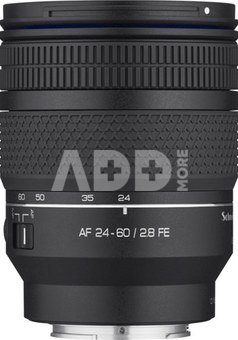
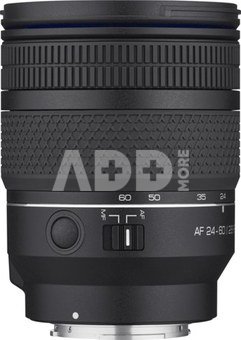
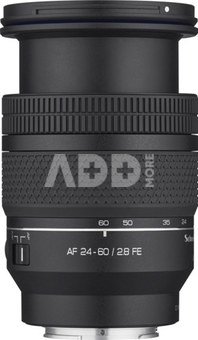
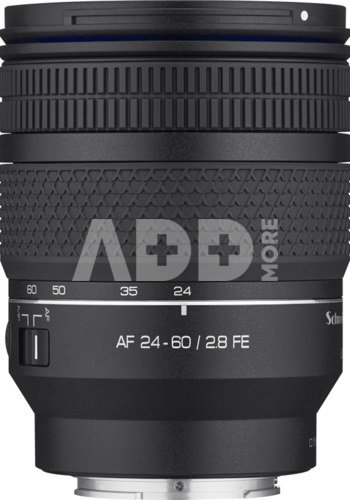
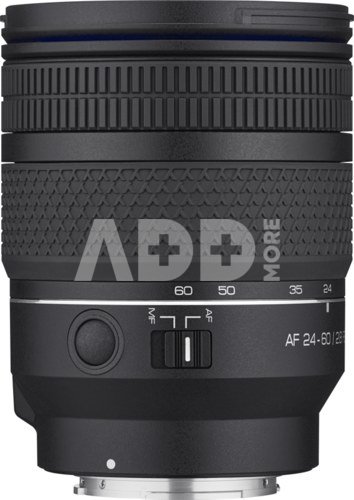
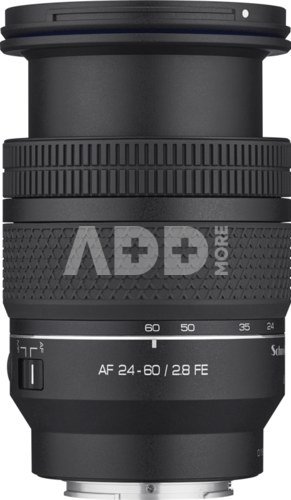
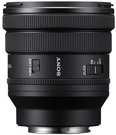
Samyang AF 24–60mm F2.8 FECo-developed with Schneider-Kreuznach, the optical design combines three HR, two ED and three aspherical elements with Samyang’s UMC coating to control aberrations and maintain crisp contrast and color across the frame. A 9-blade diaphragm produces pleasing, rounded bokeh. For both stills and video, a linear STM drive provides fast, silent autofocus with confident subject tracking, and an AF/MF switch offers quick access to manual fine-tuning when needed.Close-up work is a strong suit: focus as near as 0.18 m at 24 mm for 0.27× magnification, or 0.32 m at 60 mm for 0.25×, making detail shots easy without changing lenses. The robust aluminium barrel features IP5X dust- and splash-resistance plus water- and oil-repellent coatings, and a practical 72 mm front thread keeps filters simple.Key features• Lightweight, compact design: 494 g 102–126 mm length• Constant F2.8 aperture from 24–60 mm• Co-developed with Schneider-Kreuznach for excellent optical performance• 14 elements in 11 groups (ASP, HR, ED) with UMC coating• Video-ready linear STM autofocus AF/MF switch• Close focus: 0.18 m (0.27×) at wide 0.32 m (0.25×) at tele• Durable build with dust and splash resistance water-/oil-repellent coating• 72 mm filter sizeWhat´s in the box:LensFront and rear capLens hood
Discuss with a consultant in Kaunas
We don't have
Klaipėda Address: Birželio 23-iosios g. 23g Working hours: I-V 09:00 - 18:00 VI-VII not working Phone: +370 674 59488
Discuss with a consultant in Klaipėda
We don't have
Klaipėda Address: Taikos pr. 17 Working hours: I-V 10:00 - 19:00 VI 10:00 - 14:00 VII not working Phone: +370 604 43972
1. How to choose the right lens for a mirrorless camera?
When choosing the right lens for a mirrorless camera, it is important to consider your photography needs and style. First, decide on the resolution and focusing distance you require. For portraits, lenses with a wide aperture, such as a 50mm f/1.8, are often preferred. If you enjoy landscapes, go for a wide-angle lens (e.g., 24mm). To capture distant objects, telephoto lenses (e.g., 70-200mm) are useful. Another important factor is the lens’s light-gathering ability, which affects performance in low-light conditions. A stabilization system can also be important, especially for longer lenses. It’s important to evaluate the build quality of the lens and the manufacturer's reputation. Try out several lenses and consider your future needs to choose the right and long-lasting investment in your photography.
2. Are all lenses compatible with all mirrorless cameras?
Not all lenses are universal for all mirrorless cameras. Different manufacturers may have different mounts, so it is important to check the lens compatibility with your camera. For example, lenses for Canon, Nikon, Sony, and other manufacturers' mirrorless cameras may not be interchangeable without adapters. It is also important to consider the sensor size. APS-C lenses may be disproportionately large for full-frame cameras. Before purchasing a lens, it is advisable to check the manufacturer's compatibility chart and consider the specific requirements of your camera. Adapters can allow the use of third-party lenses, but there may be some loss in functionality or quality.

















Reviews
0 average rating (0 votes)