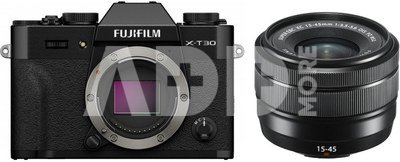
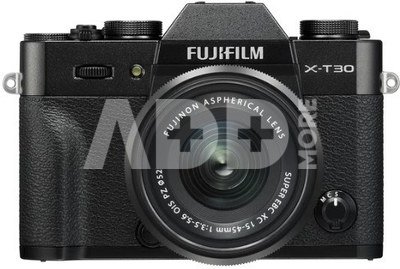
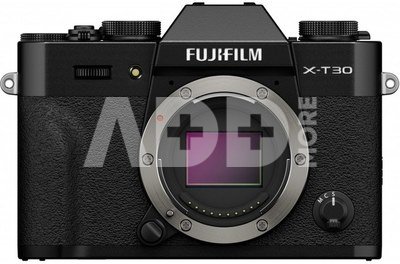
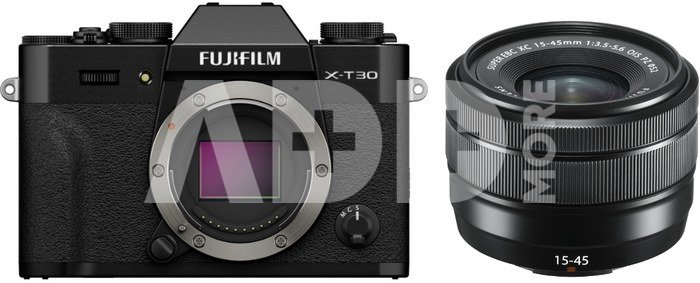
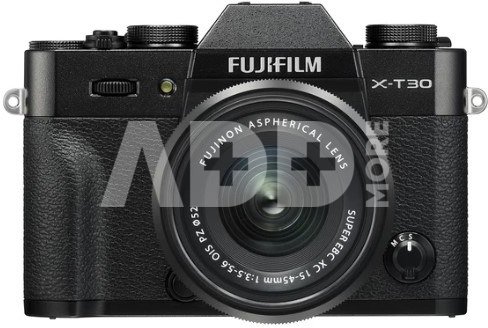
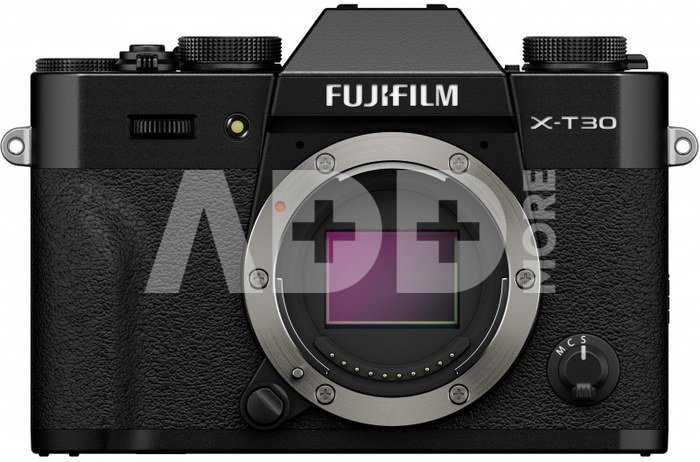
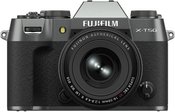
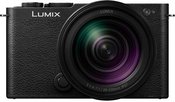
DescriptionFujifilm X-T30 III body (black) + XC15-45mm (black) description
The Fujifilm X-T30 III is a lightweight and stylish mirrorless camera that combines classic controls with modern photography and video technology. Its 26.1MP X-Trans CMOS 4 sensor and X-Processor 5 deliver detailed images, attractive Fujifilm colors and responsive performance. The included FUJINON XC15-45mm F3.5-5.6 OIS PZ covers a practical everyday focal-length range. The wide-angle setting is suitable for landscapes, architecture and interiors, while the longer end can be used for portraits, details and everyday moments. The camera also provides advanced subject-detection autofocus, internal 6.2K recording, Fujifilm Film Simulation modes and a dedicated vertical video mode for social media content.
Who is this camera for?
The Fujifilm X-T30 III with the 15-45mm lens is designed for users who want a lightweight and versatile camera for travel, family events and everyday photography.
Its Auto mode and subject-detection system make it easy to achieve good results without extensive experience. More advanced users benefit from manual controls, RAW capture, powerful video features and access to a wide range of Fujifilm X-mount lenses.
The kit is suitable for:
travel and street photography;
family, child and pet photography;
portraits and everyday images;
landscapes, architecture and interiors;
TikTok, Instagram Reels and YouTube Shorts content;
beginners purchasing their first mirrorless camera;
photographers looking for a compact second camera.
Comparison with alternatives
Fujifilm X-T30 III or Fujifilm X-T30 II?
The X-T30 III features the newer X-Processor 5, more advanced subject-detection autofocus and significantly improved video capabilities. It supports 6.2K/30p and 4K/60p recording, making it a more versatile hybrid camera.
The X-T30 II may remain a more economical option for users focused mainly on still photography, but the X-T30 III is the more modern and future-ready choice.
Fujifilm X-T30 III or Fujifilm X-M5?
The X-T30 III includes an electronic viewfinder, a built-in flash and more photography-oriented classic controls. The X-M5 is more compact and primarily designed for video content creators, but it does not have an electronic viewfinder.
For users who regularly take photographs and prefer composing through a viewfinder, the X-T30 III is the more practical option.
Fujifilm X-T30 III or Fujifilm X-T50?
The X-T50 has a higher-resolution 40.2MP sensor and mechanical in-body image stabilization. It is a more advanced but also more expensive model.
The X-T30 III is lighter and more affordable while retaining advanced autofocus, 6.2K recording, an electronic viewfinder and classic Fujifilm controls.
Key benefits
26.1MP APS-C X-Trans CMOS 4 sensor.
Powerful X-Processor 5.
Human, animal, bird and vehicle detection.
Internal 6.2K/30p 10-bit video recording.
4K recording at up to 60fps.
Full HD slow motion at up to 240fps.
Dedicated 9:16 vertical video mode.
Fujifilm Film Simulation modes.
Integrated electronic viewfinder.
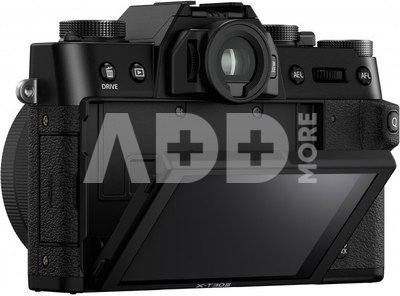
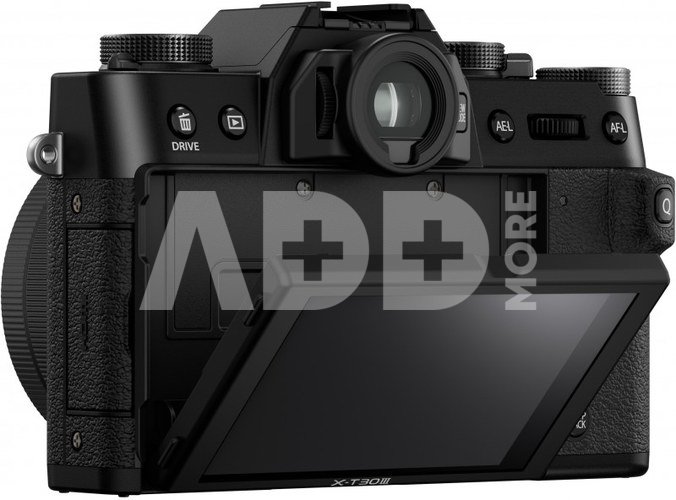
Tilting touchscreen.
Built-in pop-up flash.
Lightweight and compact construction.
Stabilized 15-45mm power zoom lens.
Wi-Fi, Bluetooth and FUJIFILM XApp support.
Frequently asked questions
Is the Fujifilm X-T30 III suitable for beginners?
Yes. The camera has an Auto mode that automatically selects exposure, autofocus and subject-detection settings. Manual controls can be introduced gradually as the user gains experience.
Does the camera have image stabilization?
The camera body does not have mechanical sensor-shift stabilization. The included XC15-45mm lens has optical image stabilization, while digital stabilization is available for video.
Can it record 4K and 6.2K video?
Yes. The camera records 6.2K video at up to 30fps and 4K video at up to 60fps. Internal 10-bit color recording is also supported.
Does the screen face forward?
No. The screen tilts upward and downward but does not rotate to face the front of the camera.
Can an external microphone be connected?
Yes. The camera has a 2.5mm microphone and remote-control connector. Compatible headphone monitoring can be used with an adapter.
Can the lens be changed?
Yes. The camera uses the Fujifilm X mount and is compatible with Fujinon XF, Fujinon XC and compatible third-party X-mount lenses.
Is the included lens suitable for portraits?
Yes. The 45mm setting provides an approximately 69mm full-frame-equivalent field of view and is suitable for everyday portraits. A brighter prime lens can provide stronger background blur.
Does the camera have a built-in flash?
Yes. The Fujifilm X-T30 III has an integrated pop-up flash.
Technical specifications
Camera
Model: FUJIFILM X-T30 III
Color: black
Lens mount: Fujifilm X
Sensor: 23.5 × 15.6mm APS-C X-Trans CMOS 4
Effective resolution: 26.1MP
Image processor: X-Processor 5
Maximum image resolution: 6240 × 4160
Image formats: JPEG, HEIF, RAW and TIFF
RAW depth: 14-bit
Standard ISO range: ISO 160-12,800
Extended ISO range: ISO 80-51,200
Autofocus: hybrid phase-detection and contrast-detection AF
Subject detection: people, animals, birds, cars, motorcycles, bicycles, trains, airplanes, insects and drones
Maximum continuous shooting: up to 30fps with electronic shutter and 1.25× crop
Maximum video resolution: 6.2K at up to 30p
4K video: up to 60p
Full HD high-speed video: up to 240p
Internal color recording: up to 4:2:2 10-bit
RAW video output: up to 12-bit through HDMI
In-body stabilization: digital stabilization for video only
Monitor: 3-inch tilting touchscreen LCD
Monitor resolution: approximately 1.62 million dots
Electronic viewfinder: integrated
Built-in flash: yes
Memory card: SD, SDHC or SDXC, UHS-I
Wireless connectivity: Wi-Fi
Bluetooth: 5.2
USB: USB Type-C
HDMI: Micro HDMI Type D
Microphone / remote connector: 2.5mm
Battery: NP-W126S
Battery life: up to approximately 425 images in Economy mode
Dimensions: 118.4 × 82.8 × 46.8mm
Weight with battery and card: approximately 378g
Body-only weight: approximately 329g
Lens
Model: FUJINON XC15-45mm F3.5-5.6 OIS PZ
Color: black
Focal length: 15-45mm
Full-frame equivalent: 23-69mm
Maximum aperture: F3.5-5.6
Minimum aperture: F22
Optical construction: 10 elements in 9 groups
Special elements: 3 aspherical and 2 ED elements
Diaphragm blades: 7, rounded
Minimum focus distance: 13cm at wide angle and 35cm at telephoto
Maximum magnification: 0.24×
Zoom mechanism: electronic power zoom
Optical image stabilization: OIS
Filter size: 52mm
Diameter: 62.6mm
Length when retracted: 44.2mm
Weight: approximately 135g
Lens mount (bayonet)
Fujifilm X
Image Sensor Size
APS-C
Maximum Resolution6240 × 4160
Discuss with a consultant in Kaunas
We don't haveKlaipėdaAddress: Birželio 23-iosios g. 23gWorking hours: I-V 09:00 - 18:00VI-VII not workingPhone: +370 674 59488
Discuss with a consultant in Klaipėda
We don't haveKlaipėdaAddress: Taikos pr. 17Working hours: I-V 10:00 - 19:00VI 10:00 - 14:00VII not workingPhone: +370 604 43972
1. Which mirrorless camera should I choose for better photo results?
Choosing the right mirrorless camera for better photo results depends on your individual needs and budget. The Sony Alpha a7 III is a popular choice, offering excellent dynamic range and efficient autofocus. The Canon EOS R6 also boasts high technical performance, including powerful image stabilisation. The Nikon Z6 II is another attractive choice with excellent dynamic range and high ISO sensitivity. It's important to consider the features of each model, the choice of lenses and the ability to suit your shooting style. It is recommended to read reviews and test equipment before buying, if possible.
2. What are the advantages of mirrorless cameras compared to DSLR cameras?
The advantages of mirrorless cameras over DSLR cameras include modern technology and lightness. Mirrorless cameras are more compact and lighter, making them more comfortable to carry. They often have a smaller body because they do not have a mirror system, which reduces the overall weight. The use of an electronic viewfinder allows the actual frame to be seen before the picture is taken, thus optimising composition and exposure. Mirrorless cameras have fast autofocus and some models may perform better in low light conditions. They also offer more creative options, including a range of filters and effects. The new generation of lenses offers improved performance and efficiency, contributing to higher quality photos. However, every photographer's needs are different, so it is important to consider your preferences carefully before choosing a camera.
The website uses cookies, which help you ensure quality of service. Continuing browsing, you agree with fotoaparatas.lt cookies policy.Agree


.jpg)
.jpg)
.jpg)















Reviews
0 average rating (0 votes)