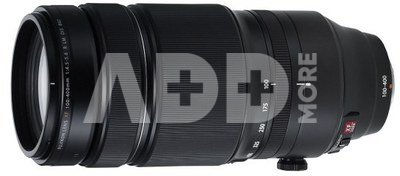
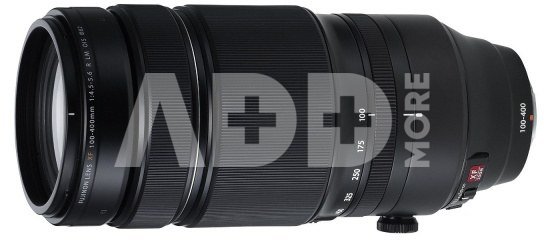
Lens Fujinon XF100-400mm F4.5-5.6 R LM OIS WR
-19%
|
The Fujinon XF 100-400mm f/4.5-5.6 R LM OIS WR is a super telephoto zoom lens that covers a 35 mm focal length equivalent of 152–609 mm. The high performance optical construction of 21 elements in 14 groups includes five ED lenses and one Super ED lens to help reduce chromatic aberration that often occurs in telephoto lenses. As a result, it delivers the highest image quality in its class. The lens has been designed for handheld shooting with a 5-stop image stabilization system and weighs less than 1.4 kg. Linear motor for fast autofocusing makes it perfect for shooting fast-moving subjects including aircraft and motorsports. The lens is also both water and dust resistant and can operate in temperatures as low as -10°C, so it’s suitable for use in a wide range of outdoor shooting conditions. A fluorine coating has also been applied to the front lens element to repel water and dirt, further improving the toughness of the lens.
Reduced chromatic aberration to help deliver high resolution images
The optical construction of 21 elements in 14 groups, which includes five ED lenses and a Super ED lens, delivers results comparable to a fluorite lens, and by reducing axial chromatic aberration it produces images packed with detail. The maximum magnification is 0.19×, enabling users to shoot telephoto macro images.
Class-leading 5-stop image stabilization
A 5stop image stabilization system — the most powerful in any super telephoto zoom lens — produces shake-free results even at the maximum telephoto setting of 609 mm (35 mm format equivalent). Also, if panning is detected, the lens automatically switches camera shake correction to the vertical plane only.
Fast, quiet AF thanks to twin linear motors
Twin linear motors are used to deliver fast focusing on moving subjects. The motors are also quiet, so the lens is ideal for shooting live music performances and theatre productions. Even faster AF shooting is possible with the focus limiter function, which limits the close focusing point to 5 m.
Compact and lightweight design
Thanks to a weight of less than 1.4 kg, the strain of shooting handheld has been substantially reduced. When mounted to an X-T1 body, the combined weight is below 2 kg, so it's easier to keep moving while shooting. What’s more, the weight distribution of the lens when attached to a body makes it feel lighter than it really is.
Water / dust resistance, -10°C low-temperature operation and fluorine coating
The lens features 13 water and dust resistant seals at 12 points, allowing you to shoot with confidence in tough outdoor environments. The fluorine coating applied to the front lens element is water repellent so it’s less susceptible to smudges and can easily be cleaned.
Lens hood with a polarizing filter window and lock mechanism
The lens hood features a sliding window so a polarizing filter can still be accessed even when the hood is in place. The hood also features a locking mechanism to keep securely attached to the lens.
Compatible with the 1.4× Teleconverter
The lens offers compatibility with the XF 1.4X TC WR teleconverter. When attached, it becomes a 140–560 mm f/6.3–8 or 213–853 mm (35 mm format equivalent). Phase detection AF shooting remains possible, even at f/8.
Typ of Sensor
APS-C
Focal length Movie
100 mm
Image stabilization
Yra
Discuss with a consultant in Kaunas
We don't have
Klaipėda Address: Birželio 23-iosios g. 23g Working hours: I-V 09:00 - 18:00 VI-VII not working Phone: +370 674 59488
Try it in Klaipėda
Have
Klaipėda Address: Taikos pr. 17 Working hours: I-V 10:00 - 19:00 VI 10:00 - 14:00 VII not working Phone: +370 604 43972
1. How to choose the right lens for a mirrorless camera?
When choosing the right lens for a mirrorless camera, it is important to consider your photography needs and style. First, decide on the resolution and focusing distance you require. For portraits, lenses with a wide aperture, such as a 50mm f/1.8, are often preferred. If you enjoy landscapes, go for a wide-angle lens (e.g., 24mm). To capture distant objects, telephoto lenses (e.g., 70-200mm) are useful. Another important factor is the lens’s light-gathering ability, which affects performance in low-light conditions. A stabilization system can also be important, especially for longer lenses. It’s important to evaluate the build quality of the lens and the manufacturer's reputation. Try out several lenses and consider your future needs to choose the right and long-lasting investment in your photography.
2. Are all lenses compatible with all mirrorless cameras?
Not all lenses are universal for all mirrorless cameras. Different manufacturers may have different mounts, so it is important to check the lens compatibility with your camera. For example, lenses for Canon, Nikon, Sony, and other manufacturers' mirrorless cameras may not be interchangeable without adapters. It is also important to consider the sensor size. APS-C lenses may be disproportionately large for full-frame cameras. Before purchasing a lens, it is advisable to check the manufacturer's compatibility chart and consider the specific requirements of your camera. Adapters can allow the use of third-party lenses, but there may be some loss in functionality or quality.
















Reviews
0 average rating (0 votes)